
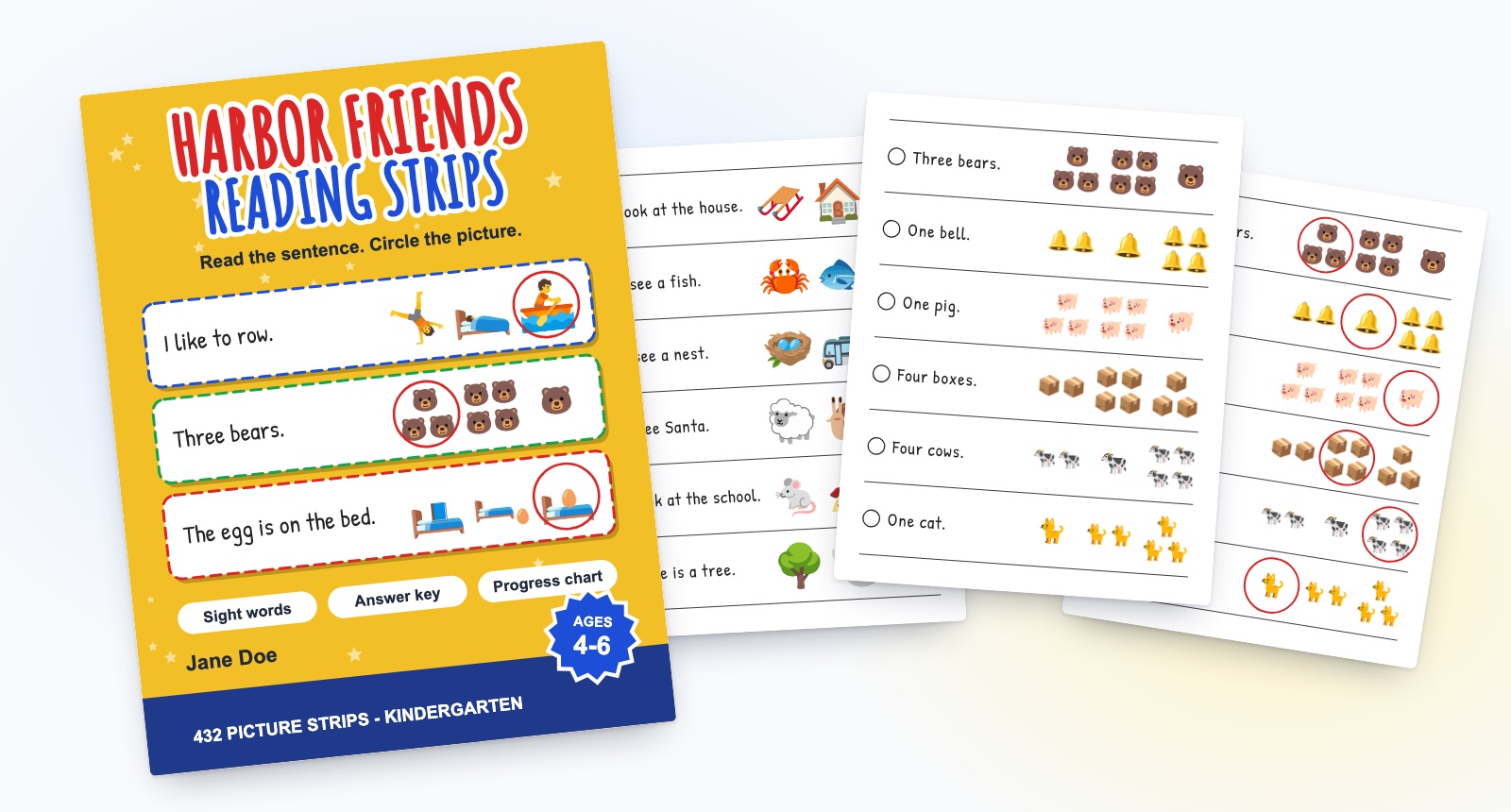
A 72-page picture-strip workbook holds 432 rows. Every row needs one sentence a five-year-old can read, one picture that matches it and two that clearly do not — then the whole book needs an answer key that stays in step with the pages. That is 1,296 picture decisions before you touch a cover. ReadStrips is a browser tool that makes those decisions with you: you choose the reader level and page style, and it writes the rows, draws the pages, builds the answer key from the same rows and exports print-ready PDFs with a wrap cover. The front-end price is $11.95 one-time, and buying through the link below also gets you my TestedApps bonus pack, delivered by email after checkout.
Get ReadStrips + My Bonuses for $11.95
What Is ReadStrips and Who Builds It?
ReadStrips is a browser-based workbook builder from DT Labs for people who publish early-reader activity books on Amazon KDP, sell printables on Etsy or supply classroom resources. It generates picture reading strips — a short sentence plus three pictures, with exactly one correct match — along with the answer key and a wrap cover, then exports the files as print-ready PDFs.
The library holds 337 open-licence pictures and the app ships with 4 readers (Pre-K, Kindergarten, Grade 1 and Grade 2), 10 difficulty levels, 8 cover layouts and up to 150 strip pages in a single book. A Kindergarten book of 72 pages carries 432 strips at six rows a page. Nothing is generated by an AI model at build time, so there are no credits to buy and no subscription attached to the output.
The commercial licence is included. You keep the publishing account, the listing and the readers; ReadStrips supplies the interior and the cover.
How Does ReadStrips Turn a Reader Level Into a Finished Book?
You make three choices and the tool does the checking. Pick the reader and the page layout, choose a cover style, then export the interior PDF and the wrap cover. Every row is assembled from the same rule set, so the answer key is drawn from the exact rows that were printed rather than rebuilt afterwards.
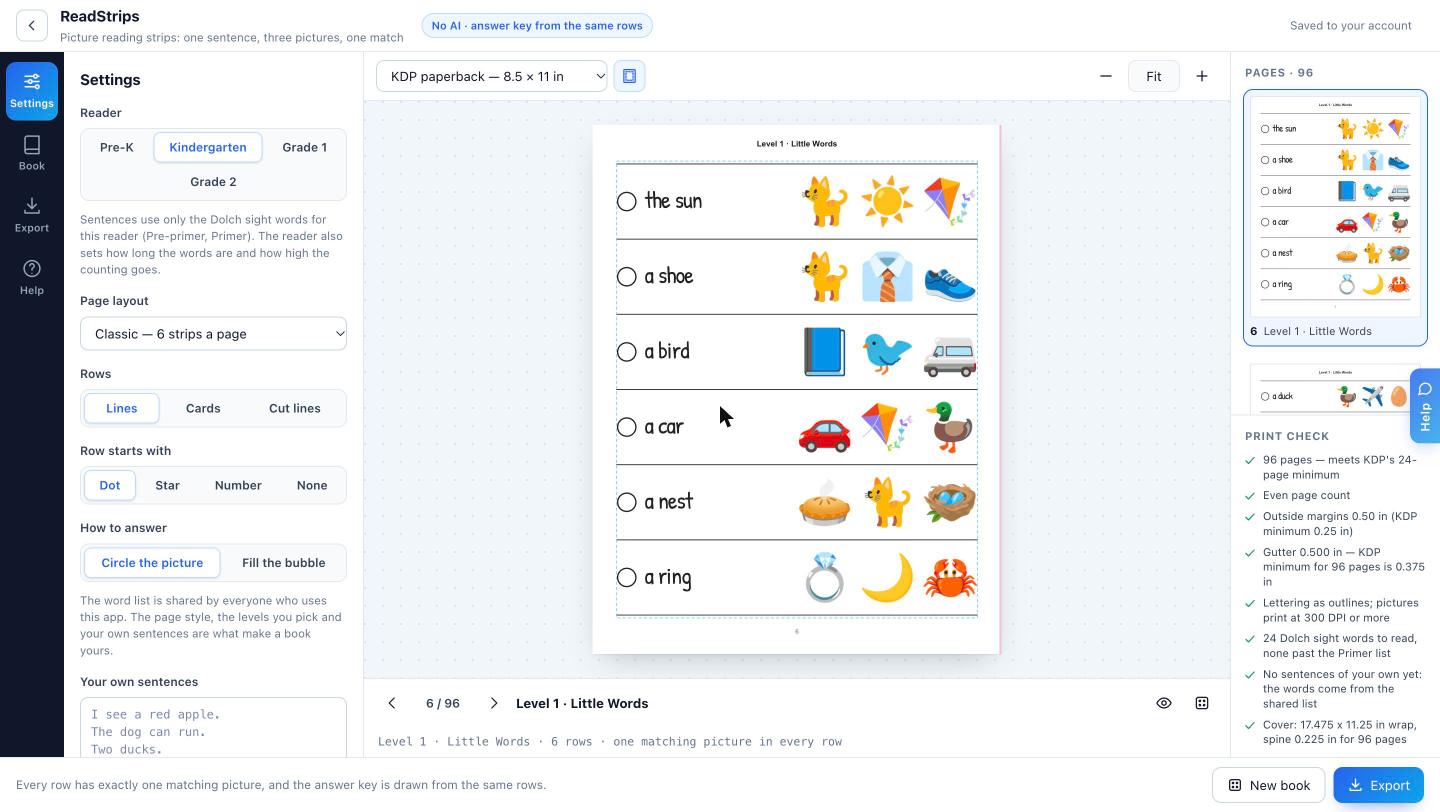
Step 1 — Pick the reader and the page. Pre-K, Kindergarten, Grade 1 or Grade 2 sets the sight words the sentences may use, how long the words are and how high the counting goes. Then choose a page layout (Classic is six strips a page), a row style and whether the child circles the picture or fills a bubble.
Step 2 — Pick a cover. Eight layouts and six colourways, or bring two colours of your own. The title, the strips on the front and the strip count all come from the book itself, and Shuffle changes the lettering, badge, marks and pattern without touching the interior.
Step 3 — Export and check the print file. The right-hand panel runs the KDP paperback checks as you work: page count against the 24-page minimum, even page count, outside margins against KDP's 0.25-inch floor, gutter against the minimum for your page count, 300 DPI pictures, and a spine width calculated from the final page count.
That print panel is the part most sellers underestimate. A 96-page book needs a 0.375-inch gutter at KDP; a 150-page book needs more. ReadStrips calculates the gutter and the spine instead of leaving you to look them up, which is exactly where hand-built interiors get rejected.
Can ReadStrips Keep Every Row Inside the Dolch Sight-Word Lists?
Yes. Each reader is tied to its own Dolch list, and the sentences are built only from words on that list plus words the child can see in the pictures. The app also runs a print check that warns you when a long book starts reusing sentences, so a 150-page interior does not quietly repeat the same twenty rows.
The 10 levels move from single words to short sentences. Two phonics levels sit alongside the eight sentence levels for children who are still blending sounds. If you want a book nobody else can reproduce, type your own sentences into the box — the word list is shared, but the page style, the levels you pick and your own lines are what make the book yours.
The look-alike rule is the other quiet win. A mouse next to a rat, or a cup next to a mug, gives a row two right answers, and a parent finds it on page 31. ReadStrips keeps look-alike pictures out of the same row, so every row has exactly one match.
What Does ReadStrips Cost for KDP Sellers in 2026?
ReadStrips costs $11.95 one-time. That price includes the commercial licence, the full 337-picture library, all four readers, the 10 levels, the cover builder and the print-check panel — with no credits, no subscription and nothing to install. The published page also carries a 30-day refund policy if the tool does not do what the page describes.
There is no per-book fee and no charge per export, which matters if you plan to publish a series. At $11.95, one sold workbook covers the tool; the rest of the series is margin. The price was read from the official ReadStrips page on 20 November 2026, the day the offer went live, so confirm the total on the checkout before you pay if the page has changed since.
What Do You Get With ReadStrips?
- A complete interior in one pass — the rows, the pictures and the answer key are generated together, so the key can never drift from the pages.
- Four reader levels with their own word lists — Pre-K through Grade 2, each held to its own Dolch sight words so the sentences actually match the child.
- A cover built from the book itself — front, spine and back in one PDF, with the spine width worked out from your page count.
- A print check that speaks KDP's language — page minimums, even page count, outside margins, gutter and 300 DPI pictures, checked while you edit.
- 337 open-licence pictures with the credit on the copyright page — no clipart hunting, no licence spreadsheet.
- A commercial licence — publish the books under your own imprint and keep the listing.
What Bonuses Do You Get With ReadStrips?
Everyone who buys through my link gets the TestedApps KDP Workbook Launch Pack on top of the tool. It is delivered by email after checkout — send your receipt to support@testedapps.com and I will send it back the same day.
- The 24-Hour KDP Picture-Book Preflight — the exact checks I run before uploading an interior: bleed, margin, gutter, page count parity and a flip-through test on a phone screen.
- 30 Sight-Word Story Starters — editable sentence seeds grouped by Dolch level, ready to paste into ReadStrips' own-sentences box when you want a book that is not on anyone else's shelf.
- The Series Planner Sheet — a one-page map for turning one reader level into a six-book series without repeating a cover style or a sentence pattern.
- Etsy Listing Copy Blocks — title, tag and description templates for early-reader printables, written for buyers who search by skill rather than by product name.
- The Answer-Key QA Sheet — a five-minute audit that catches the two failures buyers photograph in reviews: a row with two correct pictures and a key that skips a page.
Start My ReadStrips Book With the Bonuses for $11.95
What Should You Know Before You Buy ReadStrips?
- ReadStrips builds the interior and the cover; it does not upload to KDP, write your listing or set your price. You still own the publishing step.
- The 337-picture library is shared across every ReadStrips book, so two sellers can produce pages with the same art. Your own sentences, page style and level choices are what make a title distinct.
- The print check is tuned to KDP's 8.5 × 11 paperback specification. If you print at another trim size or with a different printer, verify the margins and spine yourself.
How Does ReadStrips Compare With Building the Pages by Hand?
By hand, a 72-page book means finding, licensing and placing 1,296 pictures, then rebuilding the answer key every time a row changes. ReadStrips replaces that with a rule set: look-alikes stay out of the same row, sentences stay inside the reader's word list, and the key is drawn from the printed rows. The work that remains is the creative part — choosing a reader, a title and a cover — which is the part that actually differentiates a book.
The time difference compounds across a series. A tool that produces a checked interior in an afternoon lets you test three reader levels instead of committing a month to one book. That is the real argument for $11.95: not that it removes the work, but that it moves the work to the decisions that sell.
Who Is ReadStrips For?
The KDP low-content publisher who already has activity books and wants a reading workbook line without hiring a designer. ReadStrips supplies the interior, the key and the cover wrap in the same format KDP expects.
The Etsy printable seller who needs a file a parent can print at home. The 8.5 × 11 layout and the circle-the-picture format suit a home printer, and the answer key makes the listing a complete product rather than a worksheet.
The teacher or classroom-resource creator who wants a levelled set for guided reading. Four readers and 10 levels mean one tool can cover a whole school year instead of one grade.
What Do Sellers Ask Before Their First ReadStrips Book?
Do I need design software?
No. The app runs in the browser and exports the interior and the wrap cover as PDFs. You need a PDF reader to check the file and a KDP account to publish it.
Can I sell the books I make?
Yes — the commercial licence is included. You can publish under your own imprint and keep the revenue. Check the licence text that ships with the product for the exact terms that apply to your own customers.
How long does one book take?
The generation is fast; the choices are what take time. Most of a first session goes into picking a reader, a title and a cover style. Once those are set, a second book at a different level is a matter of minutes.
Does it work for other reading systems?
The sentence builder is tied to Dolch lists. You can type your own sentences, so a school using a different sight-word sequence can still use the page builder — you just supply the lines.
Final Verdict: $11.95 for a Workbook That Would Otherwise Eat a Weekend
ReadStrips does one job and does it with unusual care: it turns a reader level into a checked, print-ready picture-strip workbook, complete with an answer key that cannot drift and a cover whose spine width is calculated rather than guessed. The 337-picture library, the look-alike rule and the KDP print panel are the details that separate a publishable interior from a folder of pages. At $11.95 one-time with a commercial licence, it earns its place in a low-content publishing stack — especially if you plan more than one book.
Claim ReadStrips + My Bonuses for $11.95
If you have already published a picture-strip workbook, I would like to know which reader level sold best for you — leave a comment below and tell me what your buyers asked for.
Some links in this article are affiliate links; I may earn a commission at no extra cost to you. Prices and offer terms were read from the official ReadStrips page on 20 November 2026. Background on sight-word instruction: Dolch word list. Print specifications: Amazon KDP paperback requirements. More launch notes live on the TestedApps Tumblr.